ISO Consultants in the UAE: A Practical Guide
Wiki Article
The Reason Uae Businesses Are In A Rush To Get Iso Certified In 2026
You can walk into any procurement conversation in the UAE in the present and ISO certification comes up within a couple of minutes. What was once a nice thing to have for larger companies has turned into a base requirement for all construction, healthcare, logistics, food production, and technology. And the speed at which local companies are exploring certification has increased noticeably over the past couple of years.Government contracts are driving a lot of the demand
The bulk of the current flurry of activity comes directly from semi-government or government tendering requirements. The majority of contracts for public sector work across the Emirates include a valid ISO certificate as a mandatory prequalification, not an optional additional requirement. This implies that those who don't have one are typically not eligible to bid prior to price or capability even enter the fray.
International Trade Partners Expect It as a Norm
The UAE's role as the regional logistics and trade hub means that a significant portion of local businesses have international partners. These businesses increasingly look at ISO certification as a fundamental credibility signal, not a differentiater. If a European or North American buyer evaluating a company based in the UAE will typically choose in part on whether or not a recognised management system certificate is in place. it is a trusted location regardless of just how well they comprehend the local market.
Free Zones Are Actively Encouraging the Certification
Certain of the UAE's largest free zones have begun to promote certification support as part of their business set-up packages which recognizes that tenants with a certification tend to be more attractive to clients as well as expand more successfully. This encouragement of the institutional level, combined with real competitive pressure has transformed certification from a specialist consideration into something that is more similar to the standard of business hygiene.
In the world of risk and insurance, Risk Considerations and Insurance are Affiliating a Growing Role
Insurance companies that operate in the UAE in the market are factoring management system certification into their risk assessment, especially for industries like construction and manufacturing that are prone to quality and safety problems. carry significant liability exposure. A certification of a safety or quality management system provides insurers with an official basis for the pricing of risk. A few are now providing more favorable terms to certified applicants because of it.
The Cost of Certifications Has Fallen
The increasing competition among certification agencies and consultants working in the UAE has reduced prices drastically compared to a decade earlier, making certification available to small and medium enterprises that previously assumed it was only available to large corporations. This shift in affordability has opened up the possibility of a wider array of companies seeking certification for the first time.
Different Standards Suit Different Businesses
Every business does not require the same certification understanding what standard is actually applicable is usually the first hurdle. A construction firm's priorities around security management appear very different from software companies' priorities around information security, which is why demand has grown throughout a variety different standards rather that focusing on just one.
What Does This Mean for Businesses Still in the Dark
If you're a company still considering whether it's worth getting certification, the practical reality in 2026 is that the question has shifted from whether competitors have it to how many small opportunities are being left with it. It typically begins through a gap analysis based on the relevant standard. It's that is followed by an organized implementation period before a formal external audit, and the overall process is much simpler than even five years ago.
The Talent Market Doesn't Have the Right Response
As certification has become increasingly integral to how UAE enterprises operate, there is the market for local talent has emerged around quality environment, and safety jobs, with more specialists possessing lead auditors who are recognized and credentials for implementation than before. This has made it significantly easier for businesses to get internal employees who can maintain a an effective management system for a long time until the first certification program closes, rather than the needing to rely entirely on external consultants indefinitely.
Multinational Companies are setting the Regional Tone
A lot of multinational corporations that operate regional or Middle East headquarters out of the UAE are bringing their existing global certification requirements along with them, in turn, they expect local suppliers or partners to adhere to similar standards. The result is a dramatic impact on local businesses who supply into these supply chains from multinational companies often observe certification requirements cascading down from the expectations of customers that originated in other countries than the UAE itself.
Certification is Increasingly Being viewed as a Growth Facilitator, Not just Compliance
Perhaps the most important shift in mindset over the last couple of years is the fact that more UAE companies now see certification as a tool that enhances growth, by opening the door to tender eligibility and international partnerships, instead of considering it as a cost to ensure compliance. This shift in perspective has made the investment considerably easier to justify internally since it links directly to revenue potential instead of being an expense that is purely part of the compliance budget.
What to Expect from the Years To Come
With the current direction and the current trends, it's reasonable to think that ISO certification will be able to move from a purely competitive advantage to an absolute access to markets requirement across an increasing range of UAE sectors over the next years. Firms that prepare for the trend, rather than waiting for certification to become mandatory, generally find the process considerably less stressful, and their standing in the market is far more solid.
What is the length of time it takes to complete the whole process? In the majority of cases, it takes
The entire process starting with a gap assessment until the moment of certification typically ranges from 3 to 9 months, dependent on the size of business and maturity of processes, as well as how quickly internal teams can take on necessary modifications. Companies with a real need to be on time tend to try to reduce this process significantly, but rushing the implementation process is likely to create a management system that does not perform well at the first review, making a reasonable timeline a genuinely worthwhile investment.
In the end ISO certifications throughout the UAE reflects a market that is now past the point of treating the management of safety and quality as an internal preference and began to view it as the fundamental element to doing business with seriousness, both locally as well as internationally. Any business that is ready to begin, the next step is an sincere conversation with an accredited certification body or a reputable consultant on which standard will meet current requirements and requirements, rather than making assumptions according to what a competitor happens to display on their website. All of this momentum does not show signs of slowing down at the moment, making this point a great time for companies still contemplating certification to move from consideration to decision. Check out the top rated ISO 9001 Certification for blog tips.

ISO 14001 Certification Why Iso 14001 Certification? Environmental Management Relevant For Uae Companies
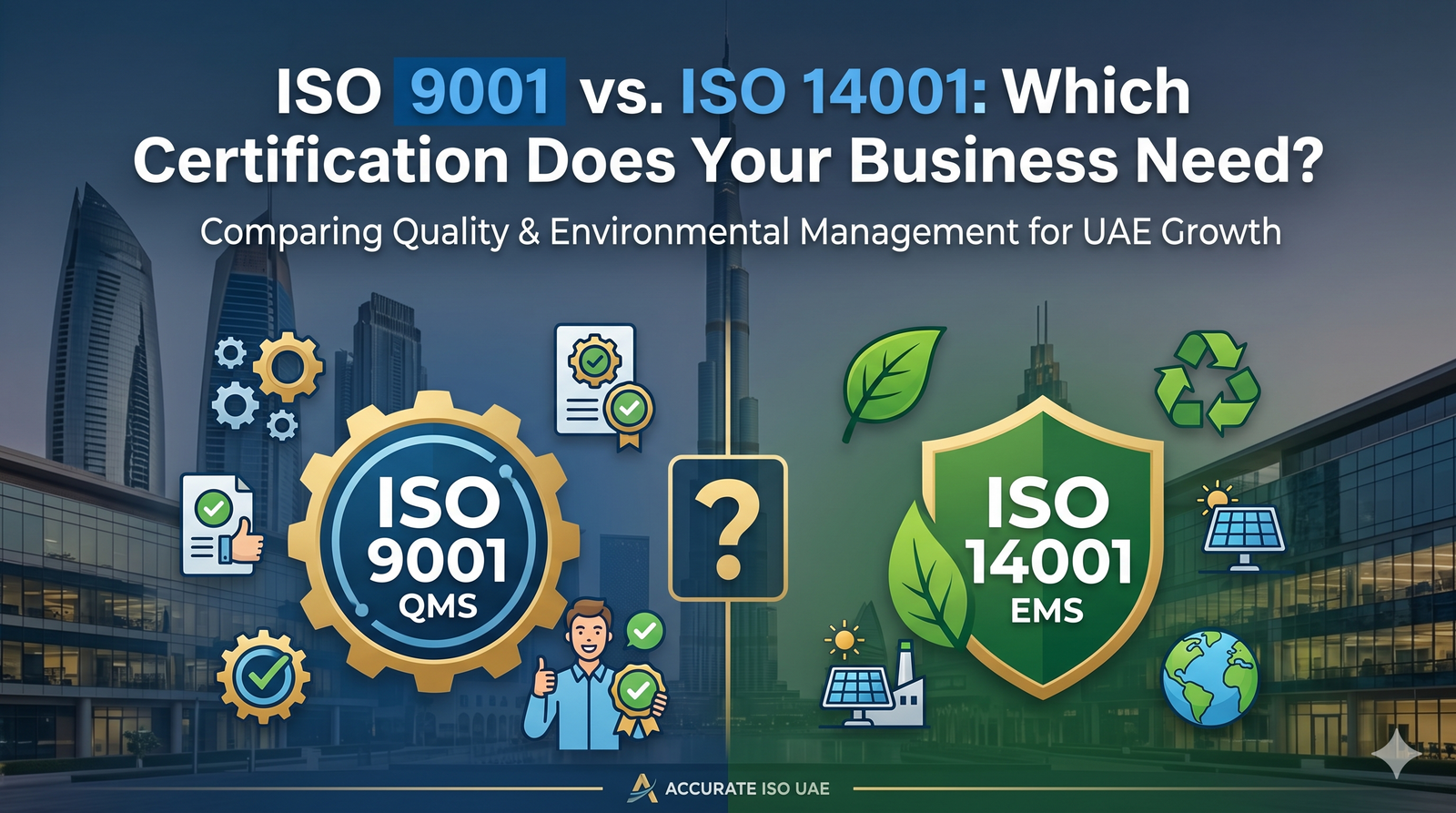
Environmental considerations have moved from an unimportant issue to the forefront of business priorities across the UAE as a result of nation-wide sustainability goals and through the rise of regulatory and customer expectations. ISO 14001, the international standard for environmental management systems, is a natural solution for businesses looking to demonstrate an actual, structured commitment to environmental sustainability rather than good intent alone.What ISO 14001 Actually Requires
The standard asks businesses to assess the environmental effects of their work, consider how they impact and then put processes in place to control and minimize negative impacts in the course of time. This could range in the area of managing emissions and waste from a manufacturing process to in reducing the amount of energy consumed and paper usage in a office-based service business, as the standard is applicable proportionally to any business's specific environmental footprint appears to be.
Alignment with National Sustainability Goals
The UAE's broader national commitments regarding sustainability and net zero targets have triggered a genuine momentum that supports environmental management. ISO 14001 certification gives individual businesses an opportunity to show their alignment with these wider goals. It is more important to align with firms bidding for government or semi-government projects, where environmental accreditation is increasingly an specific evaluation criteria.
Industries where it is most important.
Construction, manufacturing oil and gas and logistics face the most direct environmental scrutiny because of the scale of their operations. However, companies that provide services are increasingly seeking certification as well, both for tender qualification and cost savings as a result of more efficient resource use. Even businesses with a relatively less environmental footprint may find the method of arranging their operations uncovers unexpected efficiency potential.
The Legal Compliance Angle
An important aspect within ISO 14001 involves identifying and keeping track of compliance with relevant environmental legislation and the regulatory requirements. In the UAE context spans federal environmental laws and regulations that are specific to emirates. Businesses that are certified generally have a clearer and more current picture of their regulatory obligations than their competitors who are not certified, and reduce the risk of accidental non-compliance, and consequent penalties.
Integrating With Other Management Systems
Many UAE firms that have embraced ISO 14001 already hold or are currently pursuing ISO 9001, and the two standards share enough similarities in their structure that an integrated management system covering both is typically more efficient then treating them entirely distinct projects. This unified approach will reduce duplicate processes for documentation and audits for those who manage multiple certifications.
What the Certification Process looks like
As with all management system standards certification follows a standardized path: an initial gap assessment, the implementing of necessary processes and documentation internally audited, and followed by an external audit performed by an accredited certification body. In-depth surveillance audits which are usually annual, are a way to ensure that the environment management system is properly maintained instead of being a lapse after the initial certificate has been issued.
True Business Benefits beyond the Certificate
Beyond eligibility for tenders and regulatory clarity, businesses who implement ISO 14001 properly often uncover actual cost savings as a result of efficiency in resource and waste management, as well as reputational benefits for environmentally conscious customers and their partners. These practical benefits are part of the reason why environmental certification has gone beyond being merely a strict compliance requirement for a majority of UAE businesses.
Measuring What Actually Matters
Implementing a well-designed ISO 14001 system focuses measurement efforts on the environmental factors that matter most for a specific business, rather than tracking specific metrics solely due to their being easy to measure. An logistics company may focus on efficient routes and consumption of fuel and efficiency, while a manufacturing firm may be more focused on water usage and waste production that reflect where each company's actual environmental impact lies.
Engaging Suppliers and Contractors
Many UAE firms have found that a substantial portion of their overall environmental impact is attributed to contractors and suppliers rather than their own direct activities. ISO 14001 encourages businesses to consider this wider supply chain impact instead of making environmental management purely an internal matter. This has led a few certified UAE organizations to ask their main suppliers about environmentally friendly practices, which is causing gradually ripple effects through the local supply chain.
Security Preparedness for Emergencies is Part of the Standard
ISO 14001 requires businesses to detect potential environmental emergencies relevant to their operation, like chemical spills or the failure of equipment with environmental implications and have appropriate response plans in place instead of responding to such incidents reactively. This element of preparation often uncovers the gaps that businesses haven't considered, particularly around staff training for emergency scenarios.
A Standard That Rewards Genuine Commitment
In the end, ISO 14001 rewards businesses who treat environmental management as an ongoing priority for their operations and not merely a documentation process done once and forgotten. UAE businesses that incorporate the standard's principles into daily decision-making rather than separating it as a separate compliance unit, tend to enjoy the most relevant environmental and reputational benefits in the course of time.
The management of water is an issue that deserves particular attention in the UAE In the context of
Due to the arid climate of the United Arab Emirates and its dependence on desalinated waters Water use and management is frequently a focus of an ISO 14001 system compared with regions where water scarcity is not as urgent. Businesses that incorporate water efficiency into their environmental control system immediately have this among the top beneficial aspects of ISO 14001 certification within the local setting.
For UAE businesses that meet the requirements of ISO 14001, the certification represents both a response to real regulatory and market pressure as well as a chance to manage environmental impact more effectively, which impacts regulators, customers and the UAE's sustainable development goals across the nation. As environmental demands across the UAE continue to rise, businesses that build genuine sustainability capabilities now, rather than waiting for it to become an unavoidable requirement, will be positioned much better in the coming years. This should not feel overwhelming for smaller businesses due to the fact that standard scales in proportion, and even the smallest significant environmental improvements made consistently are likely to impress auditors far in excess of a grandiose plan that isn't followed through. The consistency of the plan, more than an individual's ambition, is the only thing that auditors and real environmental outcomes are both rewarded for. Small, sustained improvements tend outperform ambitious strategies that slow down after the first few months. See the top ISO Certification Services for website info.